The Cloud Monopoly Breaks: OpenAI's Pivot to AWS and the Shifting AI Landscape
Richard Smith
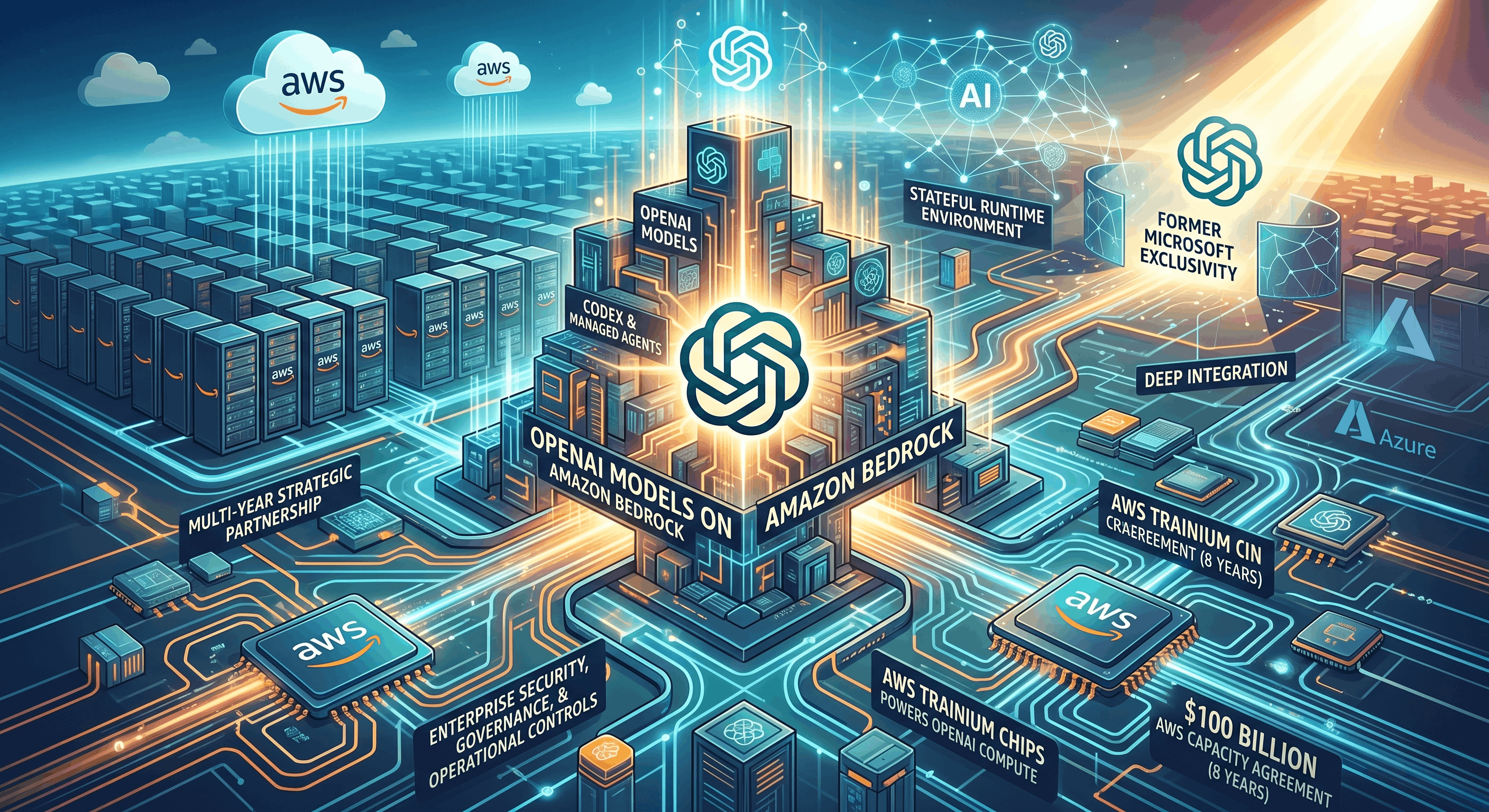
This week, the enterprise AI landscape experienced a seismic shift. After years of being synonymous with Microsoft Azure, OpenAI has officially brought its frontier models to Amazon Web Services (AWS). This move fundamentally reshapes how cloud providers compete and how enterprises deploy artificial intelligence. Here is a breakdown of exactly what happened, the context behind the multi-billion-dollar deals, and what it means for the market.
The foundational shift began with a contract renegotiation, immediately followed by product rollouts on AWS.
The End of Microsoft’s Exclusivity: OpenAI and Microsoft amended their historic $13 billion partnership. While Microsoft remains a primary partner and retains its licensing rights through 2032, the strict exclusivity clause tying OpenAI’s enterprise products solely to Azure has been eliminated. OpenAI is now free to meet enterprise customers on rival cloud platforms.
OpenAI Models Arrive on Amazon Bedrock: Within 24 hours of the restructured Microsoft deal, AWS announced that OpenAI’s latest models (including the GPT-5.5 frontier model) are available in limited preview on Amazon Bedrock.
Codex and Managed Agents on Bedrock: Targeting DevOps and software engineering, OpenAI’s coding-focused agent, Codex, is now offered as a managed agent on Bedrock. Furthermore, the two companies introduced "Amazon Bedrock Managed Agents, powered by OpenAI," allowing enterprises to build autonomous, multi-step AI workflows securely within their existing AWS infrastructure.
The Broader Context: Amazon's $150 Billion Bet
This week’s product integrations are the execution phase of a massive, multi-year strategic alignment established earlier in 2026.
The $50 Billion Investment: In February, Amazon committed to investing up to $50 billion in OpenAI (starting with an initial $15 billion), pivoting aggressively to ensure AWS remains the backbone of the AI revolution.
A $100 Billion Compute Agreement: To satisfy OpenAI's voracious appetite for processing power, the companies signed an eight-year, $100 billion compute agreement. Crucially, this infrastructure will rely heavily on Amazon’s custom Trainium chips, alongside traditional Nvidia hardware.
Co-building the Future: The long-term vision extends beyond simply hosting models. AWS and OpenAI are co-building a "Stateful Runtime Environment," designed to deeply integrate OpenAI's reasoning capabilities directly into Amazon’s consumer and enterprise ecosystems over the coming years.
Market Impact Analysis
The ripple effects of OpenAI breaking its Azure exclusivity are already actively reshaping market dynamics:
1. Microsoft Loses a Monopoly, Gains Certainty
For Microsoft, losing exclusive distribution rights to the world’s most sought-after AI models removes a major competitive moat that had been driving unprecedented growth for Azure. However, the restructured deal provides Microsoft with long-term financial certainty. A contentious "AGI clause"—which could have abruptly ended Microsoft's revenue-sharing rights if OpenAI achieved Artificial General Intelligence—was completely removed. Microsoft secures a predictable revenue stream from OpenAI through 2030, but it will now have to compete purely on the merits of its cloud infrastructure rather than exclusive access.
2. AWS Becomes the Undisputed "Everything Store" for AI
Amazon Bedrock has successfully positioned itself as the ultimate neutral ground for generative AI. By hosting models from Anthropic, Meta, Mistral, and now OpenAI, AWS has eliminated the need for its customers to look elsewhere. Additionally, the $100 billion compute deal validates Amazon's custom Trainium silicon as a highly capable, scalable alternative to Nvidia's GPUs, potentially shifting the balance of power in the AI hardware market.
3. Frictionless Enterprise Adoption
For the broader market, this is a massive win for enterprise customers. Previously, organizations heavily entrenched in AWS faced a difficult choice: spin up new, complex Azure environments just to use OpenAI, or settle for alternative models. Now, enterprises can access OpenAI's coding and reasoning agents while maintaining their existing AWS security postures, data governance, and operational controls. This removal of deployment friction is expected to vastly accelerate the transition of AI tools from the "pilot and testing" phase directly into production environments.