The $166 Billion Windfall: U.S. Retailers Brace for Historic Tariff Refund Rollout
Richard Smith
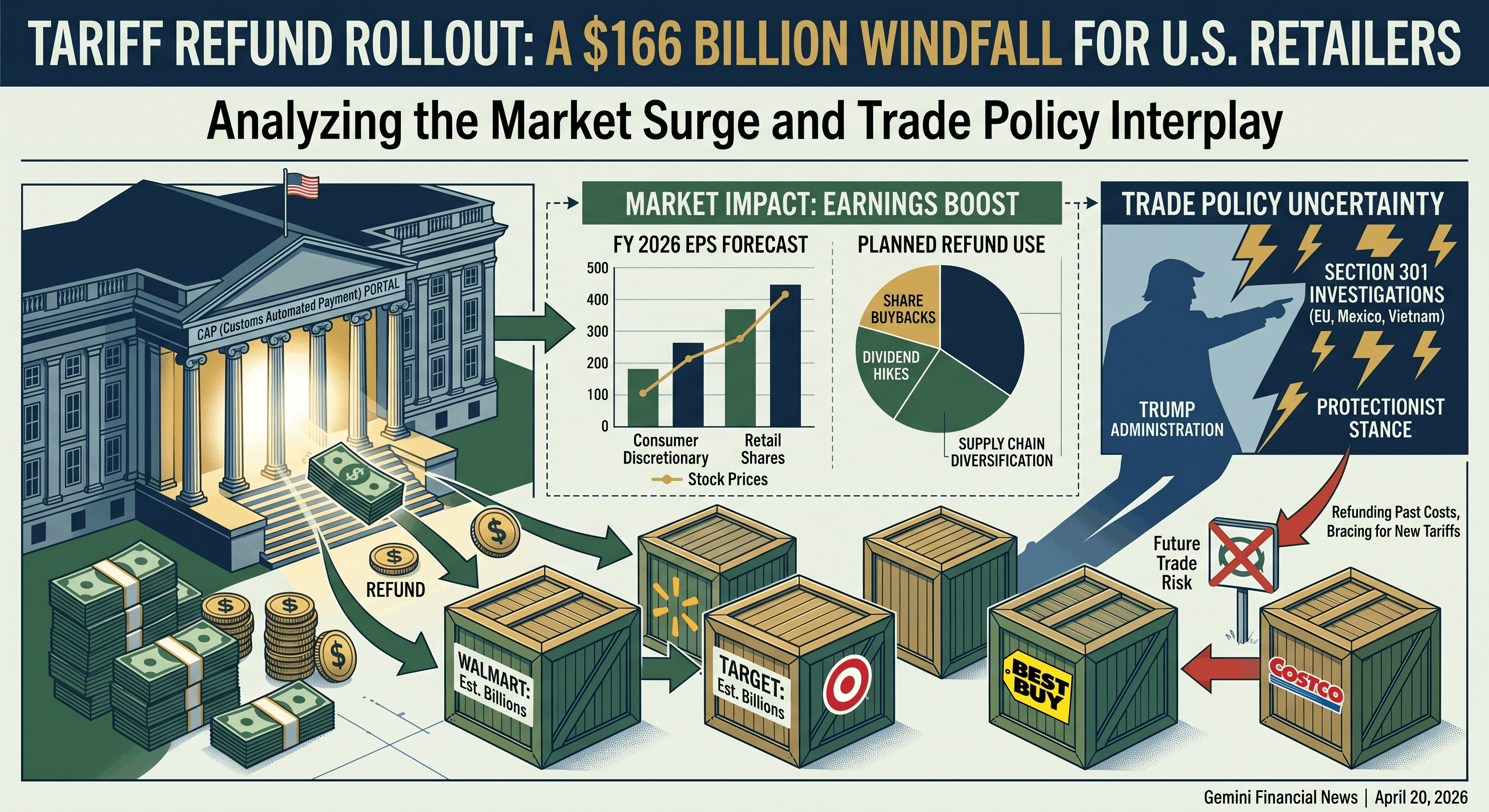
A seismic shift in trade-related cash flows began today as U.S. Customs and Border Protection (CBP) officially launched the CAP (Customs Automated Payment) portal. This digital gateway marks the start of a massive redistribution of capital, as the U.S. government begins returning approximately $166 billion in tariff payments to thousands of American importers.
The "Hidden Stimulus" for Big Retail
While the legal battle was fought in Washington, the victory lap is being run on Wall Street. Large-cap retailers, which absorbed billions in costs during the 2025 trade volleys, are the primary beneficiaries.
Walmart & Target: Analysts estimate these giants could see a combined boost to cash flow in the billions. Walmart CFO John Rainey recently noted that while the recovery protocol is complex, any refund would be recognized directly in earnings.
The Margin Play: Crucially, while these tariffs were originally passed on to consumers via higher shelf prices, there is no indication that prices will drop as the refunds arrive. A survey of 25 major CFOs revealed that 0% plan to lower prices. Instead, the "refund windfall" is expected to fund:
Share Buybacks: Accelerating existing repurchase programs.
Dividend Hikes: Returning the "found money" to shareholders.
Supply Chain Diversification: Funding the ongoing "China+1" strategy to mitigate future trade risks.
Markets Affected: A Sector-by-Sector Breakdown
The ripple effects of the refund rollout are hitting specific asset classes and sectors with varied intensity:
1. Consumer Discretionary & Retail (Equity Markets)
This is the epicenter. Markets are pricing this as a significant earnings-per-share (EPS) tailwind for FY 2026.
Winners: Walmart, Target, Costco, Home Depot, and Best Buy.
The Logic: These firms have already "suffered" the margin squeeze; the refund acts as a retroactive margin expansion.
2. Technology & Hardware
Because IEEPA tariffs hit electronics and components particularly hard, tech giants like Apple, Dell, and HP are in line for substantial rebates. This provides a liquidity cushion at a time when R&D costs for AI integration are peaking.
3. Fixed Income (U.S. Treasuries)
The Treasury Department must now find $166 billion to pay back these importers.
Impact: Short-term volatility in Treasury yields as investors brace for increased issuance. Most analysts expect the Treasury to lean heavily on T-bills (short-term debt) to fund the refunds, which may keep the impact on long-term rates relatively muted.
4. The "Refund Secondary Market"
A fascinating new niche has emerged: Litigation Finance. Smaller importers, unable to wait the 60–90 days for CBP processing or lacking the administrative muscle to file complex claims, are selling their refund rights to financial players at a discount (typically 70–80 cents on the dollar) for immediate cash.
The Counter-Trend: Trump’s Pivot to Section 301
Investors should remain cautious. While the IEEPA tariffs are dead, the administration is not retreating from its protectionist stance.
Even as the portal opens for refunds, the USTR has launched fresh Section 301 investigations into 16 economies (including the EU, Mexico, and Vietnam) targeting "structural excess capacity." Unlike the IEEPA measures, these new investigations are statutorily anchored and harder to challenge in court.
Journalist's Note: The market is currently enjoying the "sugar high" of the refund checks, but the long-term trade outlook remains hawkish. For retailers, this refund might just be the "war chest" they need for the next round of trade disputes expected in late 2026.